


Monthly Newsletter - March 2026

Updated: Apr 21

Quick Links
Our Director's Update
Dear Parents and Friends,
March has been a vibrant and engaging month across AISB, with students from Early Years through to Secondary participating in a wide range of meaningful learning experiences that support curiosity, confidence, and collaboration.
Harmony Day and our International Food Fair highlighted the strength of our diverse community and reinforced the message that everyone belongs. Across the school, students also enjoyed enriching excursions, hands-on learning experiences, and events that connected classroom learning with the wider world.
Sports Days across several year levels showcased enthusiasm, teamwork, and school spirit, while activities such as Science Week, the Careers Fair, student camps, and enterprise initiatives encouraged inquiry, creativity, and real-world thinking.
It has also been wonderful to see students confidently sharing their progress during Student-Led Conferences, demonstrating growing independence and pride in their learning.
Across all areas of school life, our commitment to wellbeing, community, and a global outlook continues to guide the experiences we provide for our students as they grow into capable, compassionate, and globally aware learners.
As we approach the end of the term and the upcoming Songkran break, we wish all families a safe, restful, and joyful holiday.
Warm regards,
Henri Bemelmans
Director

Celebrating Success
Japanese Language Proficiency Test (JLPT)
Congratulations to Selar from Year 8 for her outstanding achievement in the Japanese Language Proficiency Test (JLPT).

After passing N5 last year, she showed impressive dedication by skipping N4 and successfully achieving N3 this year.
Held last December at Kasetsart University, the JLPT is a globally recognised exam taken in over 85 countries. Selar’s success reflects her perseverance and commitment to learning. We look forward to seeing her continue to strive for even greater achievements.
Outstanding Swim Meet Performance from Axyl
Axyl delivered an excellent performance at the Brighton College swim meet, showcasing both versatility and determination across all strokes. He placed 1st in the 25m backstroke, along with strong finishes of 2nd in the 25m breaststroke and freestyle, and 5th in the 25m butterfly.
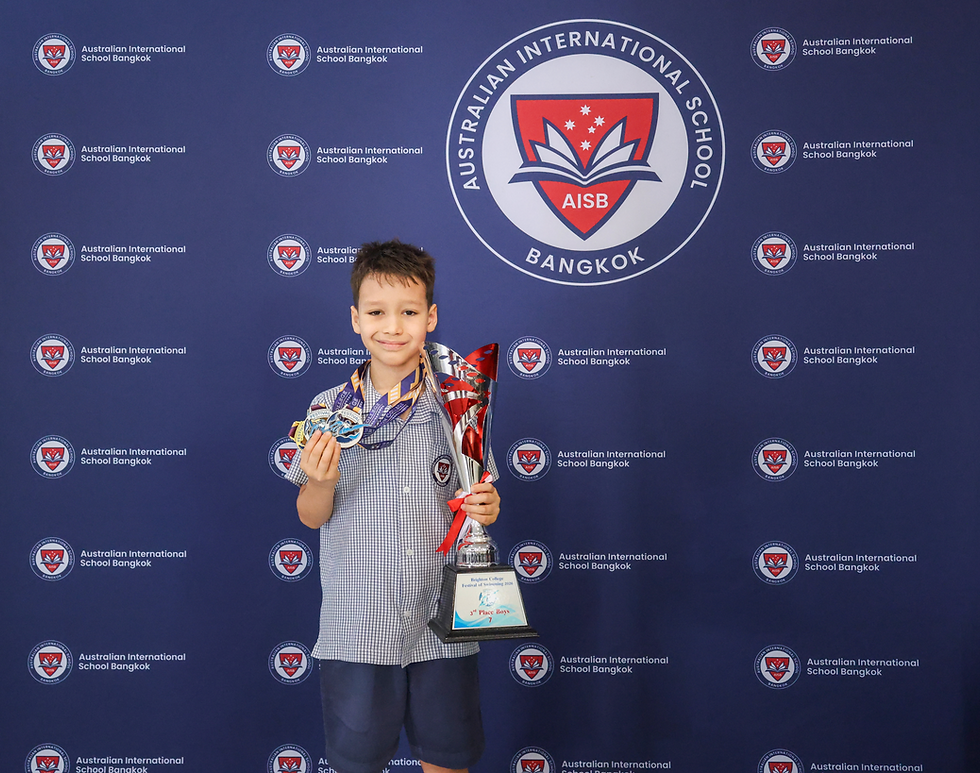
His consistent results earned him an impressive 3rd place overall in his age group. A fantastic achievement—well done, Axyl.
Congratulations to Ayvan!
We are proud to celebrate Ayaan for his outstanding achievement at the Chess Without Borders 6 tournament. Competing among nearly 120 players from around 20 schools across Bangkok, Ayaan demonstrated remarkable focus, strategy, and determination throughout the competition.

His performance reflects the perseverance, critical thinking, and love for learning that we encourage at AISB. Well done, Ayaan, your achievement is an inspiration to our school community, and we look forward to seeing your continued growth both on and off the chessboard.
Early Years Update
Written by Sheridan Musto, Head of Early Years and Soi 20 Campus
It has been an incredibly full and vibrant period across our Soi 20 campus, with a strong focus on community, wellbeing, and meaningful learning experiences both in and beyond the classroom.
Over the past few weeks, our students have been immersed in a range of engaging events and learning opportunities that reflect both our curriculum and our school values.
One of the highlights was our celebration of Love Your Pet Day, where children had the opportunity to share their connections with animals, engage in conversations about care and responsibility, and contribute to a meaningful cause through donations supporting PAWS Bangkok. We loved seeing children come to school dressed up as their favourite pet, or the pet they’d love to have. Across both campuses, we raised over 5000 baht for Paws Bangkok. This was a wonderful way to build empathy and community awareness, while also strengthening children’s confidence in expressing their ideas and experiences.
Our PreK2 students also enjoyed a rich learning experience during their excursion to the Butterfly Garden. This provided a valuable opportunity to connect classroom learning with the real world, as students explored life cycles, observed natural environments, and engaged in hands-on inquiry. Experiences like these are key in supporting curiosity, language development, and deeper understanding through authentic contexts.
Across the campus, we also came together to celebrate Harmony Day, recognising and embracing the diversity within our school community. Students participated in activities that promoted inclusion, respect, and a sense of belonging, helping them to understand and appreciate the many cultures that make up our AISB community. It was fantastic to see students confidently engaging with these ideas and celebrating what makes each of us unique.

This focus on relationships and community was further strengthened during our recent Bounce Back Assembly, where our theme of Positive Relationships was explored in connection with our AISB value of Community. Students were recognised for demonstrating kindness, cooperation, and respect in their daily interactions. These assemblies continue to play an important role in building emotional literacy and reinforcing the behaviours that support a positive and inclusive school environment.

This was followed by our Sports Days, which were a fantastic showcase of energy, enthusiasm, and school spirit across PreK2, Foundation, and Year 1, held at the Soi 31 Sports Center. The focus throughout these events was on participation, encouragement, and collaboration, with students supporting one another and taking pride in their efforts. It was wonderful to see such strong community engagement and enjoyment from both students and staff, and a very big thank you to our parents and family members from Foundation and Year 1 who joined us.

PreK2 and Foundation video: https://www.facebook.com/share/v/1DSfEekxdB/
We also had the pleasure of celebrating our students’ efforts at this Assembly through our Sports Awards, recognising not only skill but also perseverance, teamwork, and positive participation.

Another special moment during this period was our Usmile School Photo Week, where students had the opportunity to capture both individual and class memories. Thank you to families for your engagement in family photos and for your support in ensuring this ran smoothly - we look forward to sharing these photos with you.
We would also like to thank families for their continued support with school uniform expectations, particularly during photo week. Maintaining a consistent and appropriate uniform remains an important focus across the campus. As a reminder, PreK2, Foundation, and Year 1 students are required to wear black shoes. Crocs are not suitable for school, as they do not provide the necessary support and safety for running, climbing, and developing gross motor skills.
We also greatly valued the opportunity to connect with families during our Parent-Teacher Meetings in Early Years and Student-Led Conferences in Foundation and Year 1. These conversations are an important part of our partnership with families, allowing us to share each child’s progress, celebrate achievements, and discuss next steps in learning. It was particularly pleasing to see students confidently sharing their learning during the student-led conferences, demonstrating ownership and pride in their development.
Across all of these experiences, a key focus in classrooms has remained on strengthening language development, communication, and early literacy skills. Through intentional teaching, small group work, and play-based learning, we are supporting children to build confidence in expressing their ideas, engaging in conversations, and developing the foundational skills needed for future learning. This is particularly important as we support our learners in becoming confident, capable communicators within an English-speaking environment.
Overall, it has been a highly positive and productive month across the Soi 20 campus. The strong relationships between students, staff, and families continue to underpin everything we do, and we are incredibly proud of the way our community comes together to support each child’s learning and wellbeing.
Thank you, as always, for your ongoing support.
Primary Update
Written by Hannah Carew, Head of Primary
March has been a vibrant and engaging month across the Primary School, filled with opportunities for learning, connection, and celebration.
We proudly recognised Harmony Day, celebrating Australia’s cultural diversity and reinforcing the message that Everyone Belongs. Students wore orange to symbolise unity and respect, while also acknowledging the importance of inclusion. This day aligns with the UN International Day for the Elimination of Racial Discrimination and provided a meaningful opportunity for students to reflect on multicultural understanding within our community.
Our students also enjoyed a range of enriching experiences beyond the classroom. Year 6 visited WOW Park, where they explored scientific concepts connected to their learning and Year 4 took part in team-building activities at Get Growing Park, embracing the opportunity to collaborate, problem-solve, and, of course, get wet and muddy along the way!


In the lower primary years, our Foundation, Year 1, and Year 2 students had a fantastic Sports Day on the green space. The day was filled with laughter, enthusiasm, and a healthy sense of competition. It was wonderful to see so many families join us in supporting the students and promoting an active lifestyle. We extend our thanks to the PE department for organising such a successful and enjoyable event.


Year 1 and Year 2 video: https://www.facebook.com/share/v/187dGQqseG/
As the month drew to a close, students proudly shared their learning during the Student-Led Conferences. It was inspiring to see their growing confidence and ownership of their learning, reflecting AISB’s ongoing commitment to student voice and agency. We thank our parents for their continued support in strengthening this important partnership.
As we move into April and the weather becomes warmer, we kindly remind families to ensure that students bring their school hat and a water bottle each day to stay protected and hydrated.
We are also looking forward to celebrating Songkran, with our Thai teachers preparing a vibrant temple festival experience for the final day of Term 2. Please note that the last day of term is Thursday 9th April, with the Songkran break beginning on Friday 10th April. Students will return to school on Tuesday 21st April. We wish all families a safe and happy Songkran break.
Year 6 Induction
The Science Department was delighted to host this year’s Year 6 Induction, welcoming students into the labs for an exciting introduction to secondary school science.
Throughout the session, students rotated through a series of hands-on activities led by our specialist teachers. Dr Dean and Mr Johnny introduced students to electrical circuits, where they explored how components connect to create a working system. With Ms Samantha, students became familiar with essential laboratory equipment, learning how to identify and safely use key tools they will encounter in their science lessons. Mr Tom guided students through the use of microscopes, giving them the opportunity to observe specimens up close and develop their observational skills.


In one of the most popular sessions, Mr Chris led practical work using Bunsen burners and flame tests. Students were taught how to handle equipment safely while observing the distinctive colours produced by different elements—an engaging and memorable experience for many.
The enthusiasm and curiosity shown by the Year 6 students throughout the induction was fantastic to see. They approached each activity with confidence and excitement, fully embracing the opportunity to work in a real laboratory setting. By the end of the session, all students had successfully earned their lab licences, demonstrating their understanding of key safety procedures.
We are incredibly proud of how well the students conducted themselves and look forward to welcoming them back in August as they begin their science journey in secondary school.
School Value - Global Outlook
Global Outlook at AISB encourages students to understand their role as global citizens and their responsibility to protect and improve the world. This includes demonstrating cultural awareness through respect, curiosity, and openness to diverse perspectives; showing responsibility by recognising the impact of their actions locally and globally; and fostering curiosity to explore and understand different cultures and issues.
Students are also encouraged to practise sustainability by making mindful, ethical choices that protect resources for future generations, embrace and respect differences with empathy and inclusivity, and act as positive role models who influence others through their attitudes, values, and behaviours.
Bounce Back theme -Humour
In Bounce Back students will be learning about how humour is a powerful way for people to connect, cope, and build resilience. Sharing laughter helps strengthen relationships, improves wellbeing, and can bring light to difficult situations by offering perspective and releasing tension from feelings such as sadness, anxiety, or disappointment. It can also support physical health and help children feel better, while encouraging them to uplift others in kind and respectful ways.
However, humour should never be used to hurt others or avoid dealing with problems; instead, it should be used thoughtfully to support emotional expression, connection, and positive interactions.
Secondary Update
Written by Michael Bryce, Head of Secondary
A Busy Month in the AISB High School
Welcome to another news update from our High School.
It has been a busy and exciting month across the High School community, with many engaging activities and memorable events. We hope you have had the opportunity to view the photographs shared by our Media team, capturing the highlights of student life throughout the month.
From academic celebrations to community events, our students have had many opportunities to learn, explore, and connect.
Highlights from This Month
Science Week
Students enjoyed a vibrant Science Week, filled with engaging activities that encouraged curiosity, experimentation, and critical thinking. It was a fantastic opportunity for students to explore science beyond the classroom and develop a deeper appreciation for scientific discovery.

Careers Fair
Our Careers Fair was another highlight, where many of our generous parents volunteered their time to share insights into their professional journeys. These discussions helped students gain valuable perspectives on future career pathways and the skills needed in different industries.
Book Week
Book Week brought creativity and a love of reading to life across the school. Students participated in activities that celebrated storytelling, imagination, and literature.
Student Camps
Our Year 7, 8, and 9 camps were packed with opportunities for teamwork, leadership, and outdoor learning. These experiences allow students to build friendships, develop independence, and create lasting memories outside the classroom.


Year 6 Science Lab Licences
We were delighted to welcome Year 6 students to the High School Science Department, where they earned their Lab Licences in preparation for next year. The visit gave students an exciting introduction to High School science and laboratory safety.
Enterprise Marketplace
Students in our Enterprise classes hosted a lively Marketplace event in the Kirribilli Undercroft. This initiative allowed students to showcase their entrepreneurial thinking while running their own stalls and sharing creative ideas with the school community.
International Food Fair and Harmony Day
One of the most colourful events of the month was the International Food Fair, which celebrated the rich cultural diversity within the AISB community. Parents generously prepared dishes representing more than a dozen international cuisines, creating a wonderful opportunity for students and staff to experience foods from around the world.
We extend our sincere thanks to all the parents who contributed their time and culinary expertise. Their efforts in preparing food, presenting dishes, and wearing traditional national dress helped create a truly memorable celebration.
The event was moved to 27 March to accommodate the Junior Camps originally scheduled on the same date. On the day, students and staff were also invited to wear orange, the international colour representing cultural harmony, or their national costume.
It was a vibrant and joyful celebration that reflected the inclusive and diverse spirit of our school community.
Upcoming High School Events
March 23 – April 3
A Level Mock Exams (Years 11 & 12)
April 3
School Awards Assembly and presentations by classes 7G and 7E
April 8
Swim Carnival at AISB (9:25–12:25)
April 8
Interim Progress Reports Issued
Years 7–10: Interim reports
Years 11–12: Mock examination reports
April 9
Songkran Celebrations in High SchoolLast day of the term.
April 21
First Day of the Final Term for Students
April 25
ANZAC Ceremony at AISB5:45 AM – All members of the community are welcome to attend.
April 28
Study Leave Begins for Summer Cambridge Exams(Years 10–12 only)
Thank you for your continued support of the AISB High School community. We look forward to an exciting final term filled with learning, celebrations, and important milestones for our students.
Until next time
Michael Bryce
HoSS
STEAM Update
Written by Mr Gareth Openshaw, Head of STEAM
This month we had a professional learning session about the benefits, drawbacks, and ethical considerations of using AI in school. The session was discussion based, where teachers grouped up to share their own expertise and perspectives on using AI.
Lots of positive use cases of AI were identified including:
Time saving/efficiency improvements
It can be used as a proof-reading tool
It can quickly differentiate reading passages to different levels
It can help as a brainstorming tool
Some of the drawbacks identified were:
Having to check the accuracy of the output
The risk of becoming dependent on AI tools
It can be generic
‘Hallucinations’ by the AI
It can lack originality
And the ethical considerations our teachers identified were:
Data privacy and security
Bias in the AI model from the training data
Professional integrity is compromised
Environmental concerns (AI data centres take a lot of power and water to operate)
Copyright considerations - what data was used to train the AI model
The session was very productive, with teachers sharing their knowledge and understanding with each other in a collaborative manner. AI can bring a lot of benefits, but we must ensure that we use it for specific purposes, that we are the ones doing the thinking, and we always keep a human in the loop.
Creative and Performing Arts
AISB Monologue Competition 2026
The AISB Monologue Competition is now underway, and we are excited to see students across the secondary school preparing their performances.
This extra-curricular opportunity encourages students to develop confidence, creativity, and communication skills, while also supporting their wider education portfolio. Through preparing a solo monologue, students build independence, presentation skills, and a deeper understanding of character and storytelling.
Students are asked to prepare a fully memorised solo monologue in one of four categories: Contemporary, Classical, Screen, or Original/Devised. All performances should be filmed and submitted via the Google Form by 3rd April.
Following submissions, selected finalists will be invited to perform live in Assembly on 23rd April. Winners from Years 10–12 will receive an email invitation to perform at the CAPA Festival on the evening of 7th May.
We encourage parents to support students in rehearsing and preparing their monologues at home. Full competition guidelines have been shared with students and are available upon request.
We look forward to celebrating the creativity and talent of our students.
Music Notes
On Saturday, 21st March, an AISB music ensemble consisting of members Hana, Kai, Aiden, and Sierra competed in a multi-schools band competition at the Education Fair at the InterContinental Hotel, Bangkok.
Although the standard of the competition was exceptionally high, the AISB band rose to the occasion, performed very well and managed to take home 2nd place.
We are very proud of these students for this wonderful achievement, as well as helping showcase the talents of AISB students to the wider community. Well done Hana, Kai, Aiden and Sierra! Many thanks to Ms Yoko for accompanying them there.
Sports and ASA
Chess continues to inspire young minds around the world. When Gukesh Dommaraju became the youngest World Champion after defeating Ding Liren, it showed what dedication and passion can achieve. At Australian International School Bangkok (AISB), our students are discovering the excitement of the game through regular competitions such as Chess Player of the Month and our invitational tournament Chess Without Borders, where students from schools across Bangkok come together to compete, learn, and enjoy the spirit of chess.
Across AISB campuses, chess teachers guide students through the fundamentals of the game, from setting up the board to understanding how each piece moves and developing basic strategies and tactics. At the Soi 20 campus, lessons also emphasise sportsmanship and creative learning, using songs and movement to help students remember key concepts. Through chess, students build focus, critical thinking, and resilience—skills that extend far beyond the chessboard. ♟️
Masterpiece Makers After School Activity In our Masterpiece Makers After School Activity, the children have been exploring a wide range of creative experiences, where the focus is on process over product, allowing their ideas to lead the way.
Children explored a range of hands-on art activities, including rainbow scratch paper, tie-dye effects, clay sea creatures, and layered painting inspired by artists such as Piet Mondrian.
These experiences supported fine motor development, focus, and creativity. Children were encouraged to experiment, make their own choices, and build confidence in their ideas, reflecting our AISB value of Personal Best as they expressed themselves as young artists. 🎨
Excursions and Field Trips: Learning That Lasts a Lifetime
Reflecting on Meaningful Learning
Take a moment to reflect on your own school years. Which experiences stand out most clearly? For many of us, it is not a mathematics quiz or a textbook chapter, but a residential camp, a museum visit, a science centre, or an outdoor adventure. These excursions often become core memories because they help us see the world in new and meaningful ways.

Why Experiential Learning Matters
Research consistently supports the educational value of experiential learning. Studies from organisations such as the Australian Council for Educational Research highlight that learning beyond the classroom strengthens student engagement, deepens conceptual understanding, and improves long-term retention. When students encounter real-world contexts, they are better able to connect theory with practice.
Developing Well-Rounded Learners
Our commitment to education extends beyond academic achievement. We aim to nurture students who demonstrate moral responsibility, critical and creative thinking, effective communication, and strong social and global awareness. Excursions and residential experiences support this vision by providing opportunities for students to apply their learning in authentic contexts while developing independence, collaboration, and leadership.
Connecting Learning to the Real World
At AISB, excursions are intentionally designed to align with our High Quality Teaching and Learning framework and our Skills and Competencies progressions. Field trips encourage inquiry, analysis, and reflection. Students ask questions, interpret information, evaluate evidence, and draw thoughtful conclusions in authentic settings.
Building Personal and Social Capabilities
Excursions also support the development of important personal skills. As students navigate unfamiliar environments, collaborate with peers, and manage time and responsibilities, they strengthen confidence, resilience, and adaptability. These experiences encourage effective communication and thoughtful engagement with new ideas.
Bringing Our Values to Life
Importantly, excursions bring our AISB values into action. They foster a global outlook as students explore diverse communities and environments. They encourage responsibility and integrity as students represent the school beyond campus, and they strengthen awareness that learning extends far beyond classroom walls.
Learning That Stays With Students
Experiential learning helps students move from surface understanding to deeper mastery. A geography lesson becomes tangible when students observe urban development firsthand. A sustainability unit becomes meaningful when they see environmental initiatives in action.
Memories and Skills for the Future
Beyond academic learning, excursions create shared experiences that build belonging and connection. These moments often become powerful reference points for future learning. At AISB, excursions are not optional extras—they are
Mark Pearce
Deputy Head of Primary
Head of Teaching and Learning
The Power of the Page: Why Print Reading and Handwriting Still Matter
In a world of constant notifications, it can feel old-fashioned to encourage children to curl up with a real book and write with pencil. Yet a growing body of research suggests that paper books and handwriting are still incredibly powerful tools for learning – from Pre-Kindergarten all the way through to Year 12.
Print books and deeper understanding
Edutopia recently highlighted work by linguist and reading expert Naomi Baron showing that students tend to understand and remember more when they read on paper compared with screens. One reason is simple: screens come with distractions, messages, videos and links, while a book invites slower, more focused reading, imagination and quiet thought.
A large international review of studies published by researchers at the University of Valencia found that, over time, print reading can boost comprehension skills far more than reading the same material on digital devices. This doesn’t mean screens are bad, but it does suggest that, when the goal is deep thinking, such as studying for exams or understanding complex ideas, print has an advantage.
The Australian Council for Educational Research (ACER) has also reviewed how students use digital texts. Their work emphasises that while e-texts have many benefits, students often skim more and invest less mental effort when reading on screens, so teachers and parents need to be deliberate in how digital reading is used.
Why handwriting matters for reading
Reading and writing are two sides of the same coin. Australian researchers at Edith Cowan University found that children who develop fluent handwriting in their first year of school tend to be better readers the following year, leading them to caution against relying too heavily on technology too soon.
Other Australian work, shared through Primary Learning and the Australian Association for Research in Education, also confirms that handwriting is critical for both reading and writing development, especially in the early years. When children physically form letters, they are building letter knowledge, spelling and word-reading skills, the foundations of successful reading. At AISB we recognise that handwriting instruction improves letter-sound knowledge, spelling and word reading.
Research confirms what good teachers already know, that handwriting and reading physical books create deeper learning and stronger memory than screens alone, especially when guided by teachers, parents and trusted adults.
What this means for families (PK–Year 12)
Pre-Kindergarten to Year 2:
Share board books and picture books daily.
Let children trace words with their fingers or ‘write’ shopping lists and labels.
Encourage drawing and early attempts at writing about the stories you read together.
Years 3–6:
Keep a regular ‘print reading time’ at home with devices in another room – no TV Tuesdays.
Ask children to jot notes, new words or quick summaries by hand in a small reading notebook.
Combine reading with simple written responses: Draw and label your favourite part, write three questions you still have.
Write a letter or a postcard to a family or friend overseas or here in Bangkok. Our Thai postal service is excellent and post offices are easy to find.
Years 7–12:
Where possible, use print for core texts, exam revision and extended reading.
Encourage students to handwrite key summaries, mind maps and practice paragraphs, even if the final assignment is typed.
For digital articles, suggest printing important pieces or taking handwritten notes rather than relying on highlighting alone.
As a school, we value technology and recognise its many benefits. At the same time, the research is clear: the physical act of turning pages and putting pen or pencil to paper remains one of the most effective ways for young people to build strong, flexible brains for learning.
By protecting time for print reading and handwriting at home, you are giving your child, whether they are in Pre-K or preparing for Year 12 exams, a powerful head start.
Mark Pearce
Deputy Head of Primary
Head of Teaching and Learning
References
Edith Cowan University (2024). Writing and Reading for All research project.
Australian Association for Research in Education (AARE). Research on handwriting and literacy development.
Australian Curriculum, Assessment and Reporting Authority (ACARA). Australian Curriculum v9.0.
EAL
From an EAL perspective, maintaining strong reading and writing habits plays an important role in supporting language development for multilingual learners. Regular exposure to printed texts helps EAL students build vocabulary, comprehension skills, and familiarity with English sentence structures. Reading physical books also encourages slower, more thoughtful processing of language, allowing students to better understand meaning and context. In addition, handwriting supports the development of spelling, phonics awareness, and word recognition, which are key foundations for emerging English readers and writers.
When students combine reading with short written responses such as notes, summaries, or reflections, they strengthen their ability to connect ideas and express themselves in English. These practices also reinforce the relationship between the four communicative domains of reading, writing, listening, and speaking, which are essential for overall language proficiency. Encouraging regular print reading and handwriting at home can therefore help EAL learners build confidence, accuracy, and independence in using English across academic settings.
Mr Timothy Dickens
Head of EAL
That's all for this month!
We hope you enjoyed this month's newsletter. If you have any feedback or news you'd like to share for our next newsletter, please send us an email at enquiries@australianisb.ac.th.


