Monthly Newsletter - September 2026


Quick Links
Our Director's Update
Dear Parents and Friends,
September has been a wonderful month at AISB, filled with student achievements, leadership opportunities and meaningful connections across our school community.
We were proud to welcome the Australian Ambassador to Thailand, H.E. Mr Pablo Kang, to AISB for the OPEC Outstanding International School Student Awards. It was a valuable opportunity to celebrate our students’ achievements and recognise their contributions as young people with a global outlook. You can read more about the visit here.
We also celebrated our new Student Council leaders at the 2026–2027 Student Council Investiture Ceremony, marking the beginning of their leadership journey and their opportunity to represent their peers and make a positive difference in our community.
Across our campuses, students have continued to learn, explore and grow through classroom experiences, STEAM projects, sporting activities and opportunities to connect with others. We are also encouraging students to take an active role in sustainability through our How Green Is Our School? initiative, alongside our exploration of solar energy as part of AISB’s commitment to a more sustainable future.
Thank you to our students, families and staff for the energy, care and commitment you bring to our community. As we head into the mid-term break, I wish all our families a very happy and restful holiday. I hope you enjoy time to relax, reconnect and return refreshed for another exciting term of learning and growth.
Warm regards,
Henri Bemelmans
Director

Celebrating Success
One Small World, One Shared World
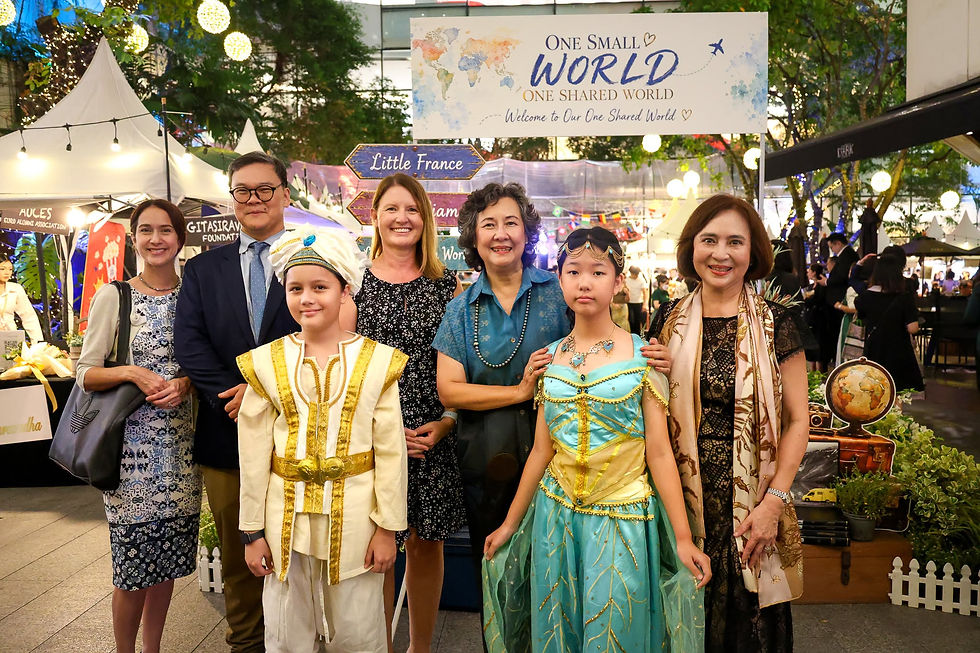
Year 6 students Lucy and Paul recently represented AISB at One Small World, One Shared World at EMQuartier, where they had the honour of meeting H.E. Mr Sihasak Phuangketkeow, Deputy Prime Minister and Minister of Foreign Affairs of Thailand, and Ms Siriluck Phataraprasit Maithai, Senior Executive Advisor of The Mall Group.
As part of the event, Lucy and Paul performed “A Whole New World,” sharing their talents with guests and the wider community.
The event brought together young people and communities to celebrate cultural diversity, friendship and connection through music and the arts.


Congratulations, Luca 🎉
We’re delighted to celebrate Luca’s achievement in the Hong Kong International Mathematical Olympiad (HKIMO).
🏅 Heat Round: Bronze Medal
🏅 Final Round: Merit Award

Well done, Luca, on this wonderful achievement and for putting your mathematical skills to the test on an international stage!
Student Council Leaders 2026/27
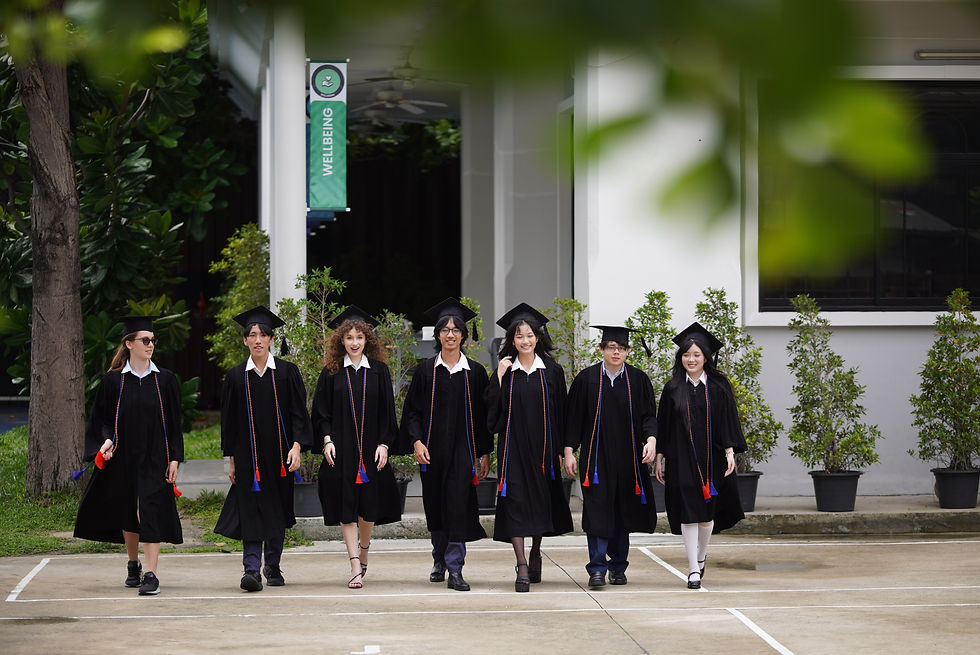
Student Council leaders 2026/27 were officially welcomed at the Student Leadership Investiture Ceremony, marking the beginning of their leadership journey at AISB.


Guest speaker Mr Paul Kenny, AISB Chairman of the Board, encouraged our student leaders to recognise when change is needed, look for solutions, bring people together and turn ideas into action, while building morale, teamwork and a shared sense of purpose.
The ceremony was an opportunity for our new leaders to reflect on what it means to represent their peers, support the wider school community and lead by example. A meaningful start to a new year of student leadership.
Early Years Update
Written by Sheridan Musto, Head of Early Years and Soi 20 Campus
September has been a wonderfully busy month at Soi 20. With the first weeks of the school year now behind us, it has been lovely to see our children moving beyond those initial settling-in days and becoming increasingly confident, connected and engaged in school life.

Across Nursery, PreK1, PreK2, Foundation and Year 1, classrooms are now firmly established as communities of learners. Friendships are growing, routines have become familiar and children are increasingly showing independence as they move through their day.
Most importantly, we are seeing our children develop a real sense of belonging — knowing their teachers, their friends, their spaces and the wider community around them.
Living Our Values
This month, we have continued to place a strong emphasis on helping children understand what it means to be part of the AISB community.

Our Dress to Impress Week was a wonderful example of this. We were incredibly proud to see our students arriving each day wearing their full school uniform with pride. While this may seem like a small everyday action, it represents something much bigger — pride in ourselves, respect for our school and a shared sense of belonging.
Congratulations to our Dress to Impress role models, Preme (Pam) from PreK2, Juan from Foundation and Krishav from Year 1, who each received a certificate and special book.
We hope all of our students will continue to be positive role models for one another as we live our values and strive for greatness every day.
Keeping Children Safe

September has also provided important opportunities to strengthen children's understanding of safety, wellbeing and looking after themselves and others.
During Child Protection Week, our Early Years children participated in age-appropriate learning experiences designed to help them understand important ideas around personal safety, trusted adults, feelings, body boundaries and speaking up when something does not feel right.
Safety learning extended across the whole campus with our fire evacuation drill. Practising these procedures helps children become familiar with what to do in an emergency while allowing our staff to continually review and strengthen our campus procedures.
These experiences are an important reminder that children's wellbeing and safety sit at the heart of everything we do.
Connecting Beyond the Classroom
One of the highlights of September has been seeing our children connect with people beyond their immediate classrooms.
We have been delighted to welcome Rebecca Kang, wife of the Australian Ambassador to Thailand, to Soi 20 as part of an ongoing series of weekly visits. Rebecca has been spending time across our Pre K2, Foundation and Year 1 classrooms, reading with children and joining small-group learning experiences.

These visits provide a lovely opportunity for our children to engage with another member of our wider Australian community in a relaxed and meaningful way, and we have loved seeing the conversations and connections developing.
Our children have also continued to enjoy opportunities to connect across classes and year levels through shared spaces, outdoor play, chess, specialist learning and our wider campus activities.
Partnering With Our Families
Our families remain such an important part of the Soi 20 community, and September has given us several opportunities to spend time together.
Our Nursery and PreK1, PreK2 and Year 1 Coffee Mornings provided relaxed opportunities for parents to connect with one another and with members of our school community. These informal conversations are incredibly valuable and help strengthen the relationships between home and school that support our children.
We also enjoyed Donuts for Dads, giving fathers and father figures a special opportunity to spend time with their children and be part of their school experience.
As we move towards Parent–Teacher Meetings and Student-Led Conferences, we look forward to another opportunity to celebrate children's progress, share their learning and talk together about their continued growth.


Learning Everywhere
Of course, amongst all of these special events, the most important work of the month has continued every day in our classrooms and learning spaces.

Children have been investigating, creating, problem-solving, reading, writing, counting, building, moving, swimming, making music and learning through play.

Our outdoor spaces continue to be an important extension of our classrooms, with children enjoying The Meadow, playgrounds and opportunities for physical activity and exploration.

Our youngest learners are becoming increasingly independent, while our Foundation and Year 1 students are embracing new challenges and growing in confidence as learners.

These everyday moments may not always be the ones that make the calendar, but they are where so much of the important learning happens.
Stronger Together
September has reminded us that a school community is built through hundreds of small connections - a child greeting their teacher in the morning, a new friendship forming in the playground, a parent stopping for a conversation, an older child modelling something for a younger one, or a teacher recognising exactly what a child needs in that moment.

We are incredibly proud of the way our children have grown since the beginning of the school year and of the care, energy and commitment our staff bring to Soi 20 each day.
Primary Update
Written by Hannah Carew, Head of Primary
Celebrating Our Primary Community
What a wonderful month it has been across Primary! We have celebrated our school values, student leadership, learning and the strong sense of community that makes AISB such a special place.


Our first AISB Challenge Day brought all Primary students together for a day of fun, teamwork and exciting challenges. It was wonderful to see students working collaboratively, supporting one another and demonstrating our value of Community as they worked towards common goals. What a fantastic day for everyone!

We also celebrated and acknowledged our Primary School Leaders and Student Council. We are incredibly proud of every student who showed courage by putting themselves forward and taking a risk. Each candidate prepared a presentation demonstrating how they could contribute to our Mission, Vision and Values and help make AISB an even better community through their actions.

At our School Leaders assembly on 18th September, students were privileged to hear from Mr Paul Kenny, a community leader and Chairperson of the AISB School Board. Paul challenged our students to consider an important question: “What does it truly mean to lead?” This is a wonderful question for us all to reflect on as members of the AISB community.

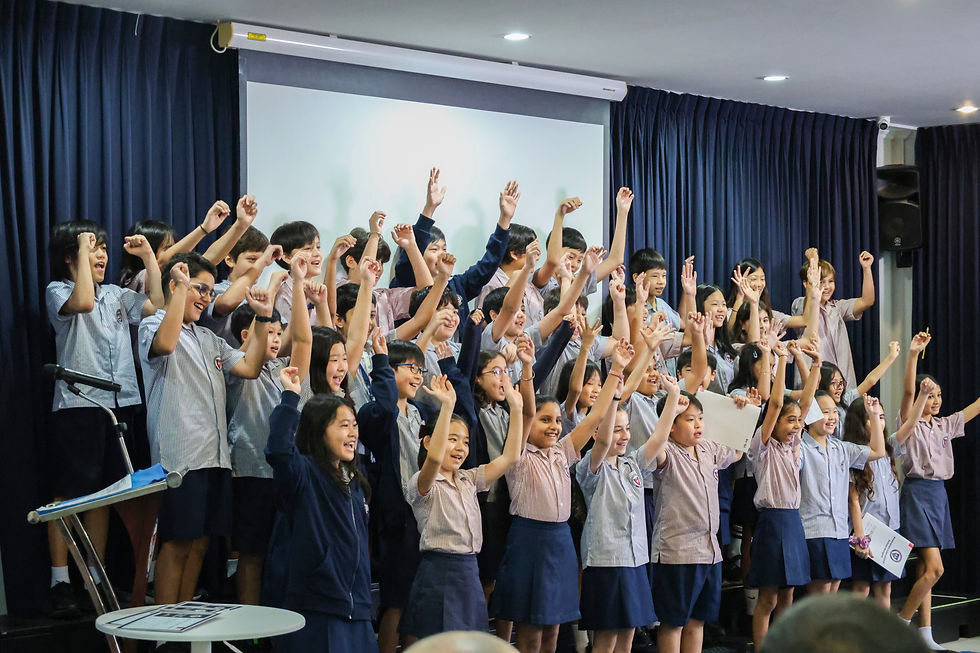
We also held our first Bounce Back and Values Assemblies across Primary, beginning at Amaroo and continuing across our Primary campuses. Congratulations to all students who were recognised for their learning, effort and positive contributions, with a focus on our Bounce Back theme of Core and Social Values and our school value of Community.


We were also very proud of our students during our first emergency evacuation drill. Every student demonstrated that they understood what to do and how to respond safely. These drills help us practise our roles and responsibilities so that we are prepared to work together to keep everyone safe.
Looking Ahead to October
October brings many exciting opportunities for learning and celebration. Student-Led Conferences will provide students with the opportunity to share their learning and progress with their parents. We look forward to seeing students proudly demonstrate what they have learned this term.
Students will also participate in Innovation Week, where our specialist teachers come together to create integrated learning experiences. It promises to be a week filled with creativity, collaboration and engagement.
Our Mid-Term Break is from 12–16 October. We wish all our families a safe and relaxing break and hope you enjoy time to reset and reconnect with family and friends.
Our October Focus
Our Bounce Back theme is Resilience. We encourage families to help children understand that challenges and mistakes are part of learning. Encourage them to talk about their feelings, try helpful thinking, solve problems and take age-appropriate responsibility. Remind them that difficult times pass and that they are never alone.
Our Values theme is Respect. We will focus on empathy, acceptance, kindness, understanding, consideration and good manners as we continue to build a kind, inclusive and supportive AISB community.
Please continue to stay connected by reading your child’s weekly homeroom newsletter for updates about learning and upcoming events.

We are incredibly proud of our students and look forward to another wonderful month of learning, growth and community.
Secondary Update
Written by James Worland, Head of Secondary
It has been lovely to see our Secondary students settle back into the rhythm of school life following the recent flooding in Bangkok. Thank you to our families for their flexibility and support during this time. There have been some great events and activities taking place across Secondary recently, helping to strengthen our sense of community and giving students plenty of opportunities to connect beyond the classroom. Our senior examination series has also got underway smoothly, and it has been encouraging to see students approaching this important period with focus and commitment.


Compassionate Young Leaders Scholarship Program
We are also excited to have launched our new AISB scholarship opportunities, open to both new and existing students. These celebrate the diverse strengths and talents within our community, recognising academic achievement, creativity and the arts. We hope this will become an annual opportunity to recognise and support students as they continue to develop their individual passions and potential.
Learn more about our scholarships program here: https://www.australianisb.ac.th/scholarships

Looking ahead, House Shirt Fridays will begin on Friday 23 October. Please remember that this is a normal school day, with students expected to attend as usual in their House shirts. Following the October break, I will also share further information about opportunities for Secondary parents to drop in, connect and meet informally. In the meantime, I wish all our students, families and staff a restful and enjoyable break, and look forward to welcoming everyone back refreshed for the second half of the term.
Tug-of-War Competition: A Fantastic Display of House Spirit!
Our tug-of-war competition was a huge success! Students competed brilliantly, showing incredible spirit, courage, determination, and commitment to our school community. Staff even stepped up to challenge the students, but despite their best efforts, the students proved too strong!


A huge congratulations to Telepea House, our overall champions! Their victory was a fantastic way to celebrate the teamwork, pride, and positive school culture that make our house events so special.
Telopea House, you did it!

Here is an update of the current points in Secondary house points

Our Year 12 students have begun their mock university interviews as they prepare for the next exciting stage of their educational journey. These practice interviews provide students with a valuable opportunity to build confidence, develop professional speaking skills, and learn how to express their ideas, experiences, and aspirations clearly.
By practising in a supportive environment, students can become more comfortable answering questions, reflecting on their strengths, and presenting themselves with confidence—valuable skills that will benefit them not only during university applications but also throughout their future academic and professional lives.


STEAM Update
Written by Mr Luke, Year 7 Art Teacher
In Year 7 Visual Art and Design, students create a personalised artwork that acts as a “time capsule” of who they are as they begin secondary school.

Students explore their identity, interests, emotions, experiences, and hopes for the future through their artwork. They can choose their own medium, such as acrylic paint, watercolour, oil pastel, coloured pencil, collage, drawing, or mixed media.

This project encourages self-reflection, creativity, and experimentation while allowing students to develop their artistic skills and begin discovering their own personal style.
Sports and ASA
Soi 20 ASA Highlight: Maths Wizards
In Foundation and Year 1 Maths Wizards, Soi 20 students strengthen their mathematical foundations through hands-on games, challenges and collaborative problem-solving. They explore number sense, skip counting, addition strategies, patterns, 2D shapes and spatial awareness.

Recent activities included skip counting 500 blocks in groups of tens and hundreds, investigating the sides and angles of 2D shapes to create colourful Shape Monsters, and practising the counting-on addition strategy through games such as Snakes and Ladders.
Beyond maths, children develop problem-solving, perseverance, collaboration and confidence while learning to take turns, share ideas and celebrate one another’s successes. These experiences make learning meaningful, engaging and enjoyable.
School Chess Championships
Our AISB students recently came together for the School Chess Championship, challenging each other across the board while showing great sportsmanship, respect and support for one another throughout the competition.
Congratulations to Ayaan, our new School Chess Champion! Well done to all the students who took part, encouraged their fellow players and helped create a positive and friendly chess community at AISB.


Global Citizenship - How Green Is Our School?
Living and learning in the heart of Bangkok gives our students a unique opportunity to think about what it means to be a global citizen in a rapidly changing city. At AISB, our value of Global Outlook asks students to understand their role as global citizens and their responsibility to “protect and improve our world.”


This year, we want to turn that responsibility into meaningful student action by asking a deceptively simple question:
How green is our school?
Our students are encouraged to become environmental investigators. We will explore five areas of school life: waste, water, energy, shade and biodiversity. How much waste do we produce? Where might water or electricity be unnecessarily used? Which parts of our campuses are coolest and best shaded? How much vegetation do we have? What birds, insects and other living things share our school environment?

Importantly, this is not simply about identifying problems. Students will be invited to collect evidence and establish a baseline, a picture of where we are now. This will allow them to identify realistic areas for improvement, take action and, later in the year, return to their data to ask an even more important question:
Have we made a difference?
This approach reflects UNESCO's Green School Quality Standard, which encourages schools to connect sustainability learning with facilities and operations, governance and community engagement. Students are not simply learning about sustainability; they are discovering that their decisions and actions can contribute to a more sustainable community.
Turning Sunshine into Action at AISB
Importantly, this commitment is also being reflected in the way AISB considers the operation of its campuses. A recent solar rooftop project for our Secondary Campus has explored how renewable energy can become part of the school's future energy use.

The proposed design considers 220 solar panels across the Highfield and Football buildings, providing a total system capacity of 140.8 kWp. Modelling for the project estimates potential annual electricity generation of approximately 194,150 kWh, demonstrating the significant contribution that Bangkok's abundant sunshine could make to reducing reliance on conventionally generated electricity.
For students, projects such as this provide something particularly powerful: a real-world sustainability case study happening within their own school. Energy use is no longer an abstract concept in a textbook. Students can investigate where our electricity comes from, examine how much we use, explore the potential contribution of renewable energy and consider how individual behaviour works alongside larger infrastructure changes.
Our School, Our City
AISB's efforts also connect with changes taking place beyond our school gates. Bangkok has been working to create a greener and more liveable city through initiatives such as the Bangkok Metropolitan Administration's Million Trees Project. The initiative seeks to expand urban greenery, increase shade, help address pollution and create more diverse habitats within the city.
For children growing up in Bangkok, this creates an authentic connection between local action and global responsibility. A tree providing shade, a garden supporting insects, lights switched off in an empty classroom, water conserved, waste prevented, or a school increasingly exploring renewable energy, may each appear to be one action. Collectively, they contribute to healthier and more sustainable communities.
Over the coming months, we look forward to sharing what our students discover through investigations into How Green Is Our School?, and, most importantly, the actions they decide should come next.
Global citizenship begins with understanding our world. It grows when we take responsibility for improving it.
Mark Pearce
Deputy Head of Primary
Head of Teaching and Learning
Pillars of School-wide Pedagogy: Differentiated Instruction
At AISB, our approach to High Quality Learning and Teaching is guided by four pillars of school-wide pedagogy: Explicit Instruction, Differentiated Instruction, Collaborative Learning and Assessment for Learning.

Together, these provide a consistent approach to ensuring students are supported, challenged and actively engaged in learning. Our Teaching and Learning Handbook for Teachers makes this connection explicit: learning should be tailored to individual needs while maintaining appropriate levels of challenge and support.
This month, we highlight the second of these pillars: Differentiated Instruction.
Every learner can succeed
At AISB, we recognise that students bring different strengths, prior knowledge, experiences, interests, cultural backgrounds, language profiles and learning needs to the classroom. Our Teaching and Learning Handbook captures an important belief underpinning our approach: “every student can do remarkable things with the appropriate guidance and support.” Differentiation therefore requires teachers to know their students well and intentionally adapt teaching and planned learning experiences so that all learners experience an appropriate level of challenge.
Importantly, differentiation does not mean creating a completely different lesson for every student, nor does it mean lowering expectations. Students should continue to work towards clearly identified curriculum learning, with teachers making deliberate adjustments that help students access, engage with and extend that learning. Enabling each learner to experience success and progress against their individual point of need is one of the many skills an agile practitioner demonstrates.
There are four elements that teachers can adjust: content, what students learn; process, how teaching and learning occur; product, how students demonstrate their learning; and the learning environment, how the classroom is organised to enable effective learning. This reflects current Australian Curriculum guidance, which emphasises equitable access, excellence and high expectations for all learners.
Evidence, not labels
Effective differentiation begins with knowing where students are in their learning. AISB's Teaching and Learning Cycle asks teachers four important questions:
Where are my students now?
What do I want them to learn?
How will they get there?
How will I know when they get there?
Ongoing assessment (formative and summative) and monitoring enable teachers to respond to student needs, provide feedback and determine appropriate next steps.
This is consistent with research and guidance from the Australian Education Research Organisation (AERO). AERO identifies checking for understanding and monitoring progress as important elements of effective instruction because they allow teachers to identify what students know, locate gaps and adjust instruction, guidance and feedback accordingly.
This also means that differentiation should remain flexible. A student may require extension in one concept or learning area while needing additional modelling, practice or scaffolding in another. Students should not be defined by fixed labels such as "high", "middle" or "low". Instead, teaching responds to the evidence of what a student is ready to learn next. At AISB we do not rank students comparative to each other. Student achievement is measured against curriculum standards, and progress is tracked from a students’ starting point.
What does differentiation look like at AISB?
In practice, differentiation is embedded within high-quality classroom teaching. Teachers may vary the level of scaffolding, questioning, modelling, time, resources, grouping, complexity, pace or opportunities for students to demonstrate their understanding. At AISB we emphasise flexibility, evidence from assessment, appropriately challenging and respectful work, clarity about essential learning, and meeting learners at their current point of development before moving them forward.
Differentiation also works alongside Explicit Instruction and Assessment for Learning. Teachers establish clear learning intentions, explicitly model new knowledge and skills, provide guided practice, check for understanding and gradually move students towards greater independence.
Support when students need more
For some students, high-quality differentiated classroom instruction is supplemented by additional targeted support. This may include in-class adjustments, small-group instruction, individualised intervention or specialist support. At AISB we define Learning Support as targeted assistance that can include each of these approaches.
Differentiated Instruction: Supporting Every EAL Learner
In an EAL classroom, differentiated instruction begins with the understanding that every student brings a unique combination of language proficiency, prior learning, cultural experiences, interests, and strengths. As Carol Ann Tomlinson explains, “A teacher in an effectively differentiated classroom seeks to develop increasing insight into students’ readiness levels, interests, and learning preferences.”
For EAL learners, this means looking beyond simply identifying a student as an English learner and considering what they can already understand, communicate, and demonstrate in English. Differentiation may involve adapting the content, process, or product while maintaining high expectations and meaningful learning goals for all students. In practice, this might mean pre-teaching key vocabulary, providing visual supports, modelling academic language, offering sentence starters, or giving students additional opportunities to rehearse their ideas before sharing them.
It can also mean allowing students to demonstrate their understanding in different ways while they continue developing the language needed for more complex academic tasks. Importantly, differentiation is not about giving EAL students “easier work”; it is about removing unnecessary language barriers so that students can access appropriately challenging learning. Tomlinson reminds us that “highly effective teachers teach students first, then content,” highlighting the importance of knowing our learners and responding to their individual needs. Ultimately, effective EAL differentiation helps students build both English proficiency and academic independence, gradually moving them from supported participation toward confidently accessing the curriculum alongside their peers.
Our English as an Additional Language (EAL) program is one example. Students may receive General or Intensive EAL support according to their level of language proficiency, with WIDA and ongoing school-based assessment used to monitor progress and adjust support. Importantly, ACARA emphasises that EAL/D learners are themselves a diverse group and require different instructional supports according to their English-language proficiency; language development can also vary across listening, speaking, reading/viewing and writing.
Extending high-potential learners
Differentiation is equally important for students who are ready to move beyond the expected level of learning. At AISB, enrichment provides opportunities to extend and deepen learning beyond the standard curriculum for students demonstrating high potential or achievement.
Australian research and guidance reinforce that high-potential students require deliberate opportunities for greater challenge, complexity, depth and pace, rather than simply receiving more work. The NSW Department of Education identifies differentiation, purposeful grouping, explicit teaching, formative assessment, pre-assessment and effective feedback as complementary approaches for supporting high-potential learners.
Similarly, ACARA recommends rigorous, relevant and engaging learning that responds to students' strengths, abilities, interests and goals. Adjustments may be made to content, process, product and learning environment, the same four elements identified within the shared expectations of our community of educators.
Challenge, support and belonging
Differentiated instruction is about more than academic achievement. It reflects AISB's commitment to inclusion, belonging and Personal Best.
Our High Quality Learning and Teaching framework identifies three imperatives for student engagement: students should feel safe, valued and respected; be actively engaged in learning at their level of need; and experience a strong sense of belonging. Students working at their level of need show curiosity, perseverance, critical thinking, collaboration, problem-solving and increased responsibility for their own learning.
Through Differentiated Instruction, we aim to provide every AISB student with what effective learning requires: high expectations, appropriate challenge, responsive support and opportunities to experience success and growth.
In doing so, we continue to work towards our shared purpose: to empower compassionate young leaders for life.
References:
Mark Pearce
Deputy Head of Primary
Head of Teaching and Learning
That's all for this month!
We hope you enjoyed this month's newsletter. If you have any feedback or news you'd like to share for our next newsletter, please send us an email at enquiries@australianisb.ac.th.